
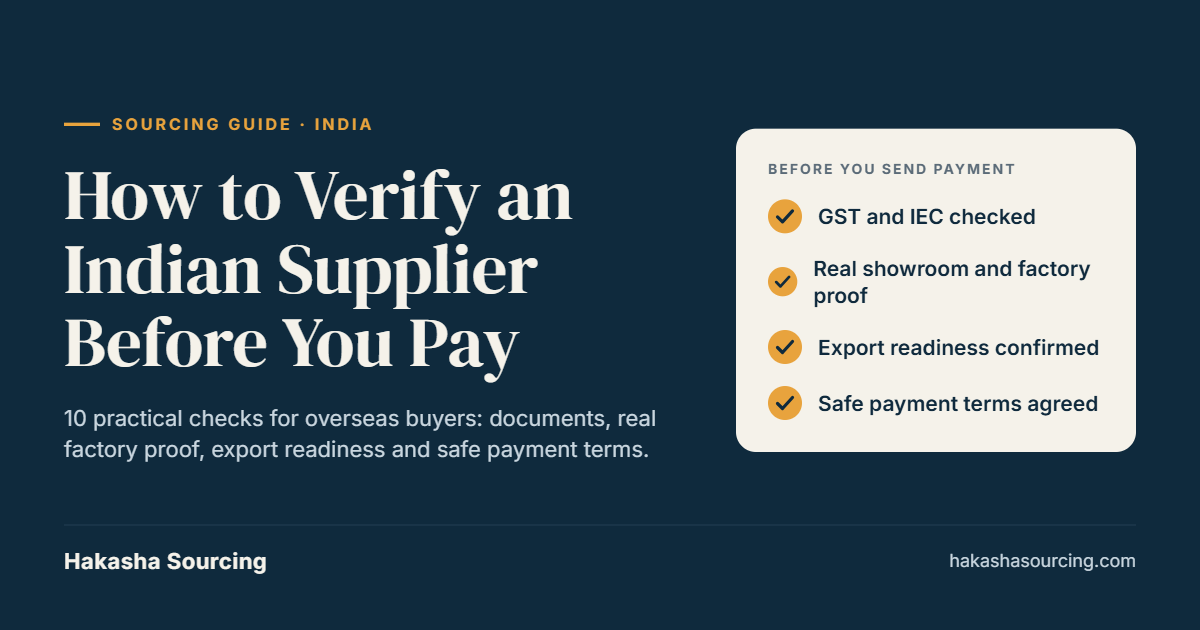
How to Verify an Indian Supplier Before Sending Payment
Worried about import scams? Discover a 10-step practical guide on how to verify an Indian supplier before sending payment. Learn how to check GST numbers, verify your manufacturer's Import Export Code (IEC), spot AI image traps, audit factories, and secure safe payment terms to protect your international orders.
A practical guide for overseas buyers sourcing products from India
For international buyers, one of the biggest concerns when sourcing from India is simple: can I trust this supplier before I send payment?
India is home to thousands of genuine manufacturers, exporters, and artisan businesses. But successful sourcing takes more than attractive product photos and competitive pricing. You need to confirm that the supplier can actually make the product, export it, document it, and deliver what they are showing you.
Most problems do not appear during quotation discussions. They appear later, when production is finished and the shipment is ready to leave India. A few days of verification up front can save weeks of delay and a lot of unnecessary cost.
Here are ten practical steps to reduce supplier risk and verify an Indian manufacturer before you pay.
Why Supplier Verification Matters
Confirms real manufacturing capability and export readiness.
Prevents shipment delays and costly surprises at the final stage.
Lays the foundation for a secure, long-term supplier relationship.
1. Verify Business Registration
Start by confirming that the supplier is a legitimate business. Ask for:
Company registration details
GST registration number
Import Export Code (IEC)
Registered company address
Official website and a business email domain
Don't just collect these documents—check them. GST numbers can be looked up on the official GST portal, and an IEC can be checked through the DGFT (Directorate General of Foreign Trade) website. Make sure the name and address match what the supplier has told you and what appears on the invoice and bank account.
Red Flag: A professional exporter should share these details without hesitation. If a supplier refuses, or works only through personal email accounts, verify further before going ahead.
2. Check Their Digital Presence
Review the supplier's online presence carefully. Look for:
A professional website and product catalogue
An active LinkedIn presence
Trade fair participation and export history
Customer references
A good website is a positive sign, but it should never be the only basis for approval. Cross-check company information across several sources and make sure it is consistent.
3. Don't Rely Solely on Catalogues and AI-Generated Images
Now that AI image tools are common, many suppliers use AI-generated product images, 3D renders, or heavily enhanced presentations. They look attractive, but they do not always show what can realistically be manufactured.
We have seen buyers approve products from beautiful digital renderings, only to find during production that decorative details, proportions, textures, or finishes could not be reproduced in real life.
Before selecting a new supplier, ask for:
Recent showroom photographs and videos
Factory walkthrough videos
Production photos of previous orders
A live video call showing actual inventory
A genuine manufacturer can show real products, not just computer-generated designs.
4. Request Product Samples
Before committing to a large order, request physical samples and evaluate:
Material quality and finish consistency
Design accuracy and weight
Packaging standards
Communication and responsiveness
Keep in mind that a good sample does not guarantee consistent mass production. Ongoing quality control remains essential.
5. Confirm Manufacturing and Export Capability
Not every supplier is a manufacturer, and manufacturing ability is not the same as export ability. Ask direct questions:
Do you manufacture the product yourself, or are operations subcontracted?
What is your production capacity?
Which countries do you regularly export to?
Have you handled similar products for international buyers?
Companies with established export experience are usually much better prepared for international documentation and communication.
6. Verify Export Readiness and Documentation
This is one of the most overlooked steps. Buyers focus on quality and price but forget to confirm that the supplier can actually export smoothly. Discuss these points before placing the order:
An active Import Export Code (IEC)
AD Code registration, which links the exporter's shipping bills to their bank
Port or airport registration
RCMC (Registration-Cum-Membership Certificate), where relevant to the product category (such as EPCH for handicrafts)
Best Practice: Don't wait until production is complete. Confirm export readiness before the order is placed and before sending any substantial payment.
7. Conduct a Factory Audit
A factory audit checks that the supplier's operations match their claims by reviewing production facilities, workforce structure, and quality control systems. If you cannot visit India in person, hiring a local representative to conduct an independent factory audit gives you vital visibility.
8. Use a Local Sourcing Partner
Many overseas buyers cannot visit factories personally. A trusted local sourcing partner can handle supplier identification, verification, factory audits, sample coordination, price negotiation, and quality inspections. At Hakasha Sourcing, this is exactly the on-the-ground support we provide for international buyers so you aren't relying blindly on emails and catalogues.
9. Agree on Safe Payment Terms
Even a well-verified supplier should not receive the full amount up front. Before you pay:
Avoid 100% advance payment. A common structure is a part advance (e.g., 30%) to start production, with the balance paid against inspection or before shipment.
Pay only to a company bank account whose name matches the registered business name on the commercial invoice. Never send money to personal accounts.
Confirm any change of bank details by phone or video call. Last-minute bank detail changes are a common import scam.
10. Start with a Trial Order
Even after verification, avoid placing a massive order straight away. Begin with a pilot order or a small production run to evaluate quality consistency, communication, delivery performance, and problem-solving.
Common Warning Signs of an Untrustworthy Supplier
The supplier cannot provide business registration, GST, or IEC details.
The catalogue contains only rendered or AI-generated images.
No recent showroom photos or factory videos are available.
Prices are unrealistically lower than competing suppliers.
The supplier resists video calls or factory verification.
Bank details change unexpectedly via email.
Indian Supplier Verification Checklist
Before sending payment, confirm that you have checked:
[ ] Business registration, GST, and IEC verified
[ ] Export readiness and documentation discussed
[ ] Physical product samples reviewed
[ ] Showroom photos or factory videos received
[ ] Manufacturing capability confirmed
[ ] Factory audit completed (if required)
[ ] Payment terms documented and bank account matched to company name
[ ] Trial order planned or completed
Final Thoughts
Successful sourcing from India starts long before production begins. The most reliable buyers do not judge suppliers on price or digital presentations alone; they verify manufacturing capability, export readiness, and real production experience.
Planning to source from India? Hakasha Sourcing offers comprehensive supplier verification, factory assessments, and on-ground sourcing support for overseas buyers. Contact us for a professional supplier check before you pay.
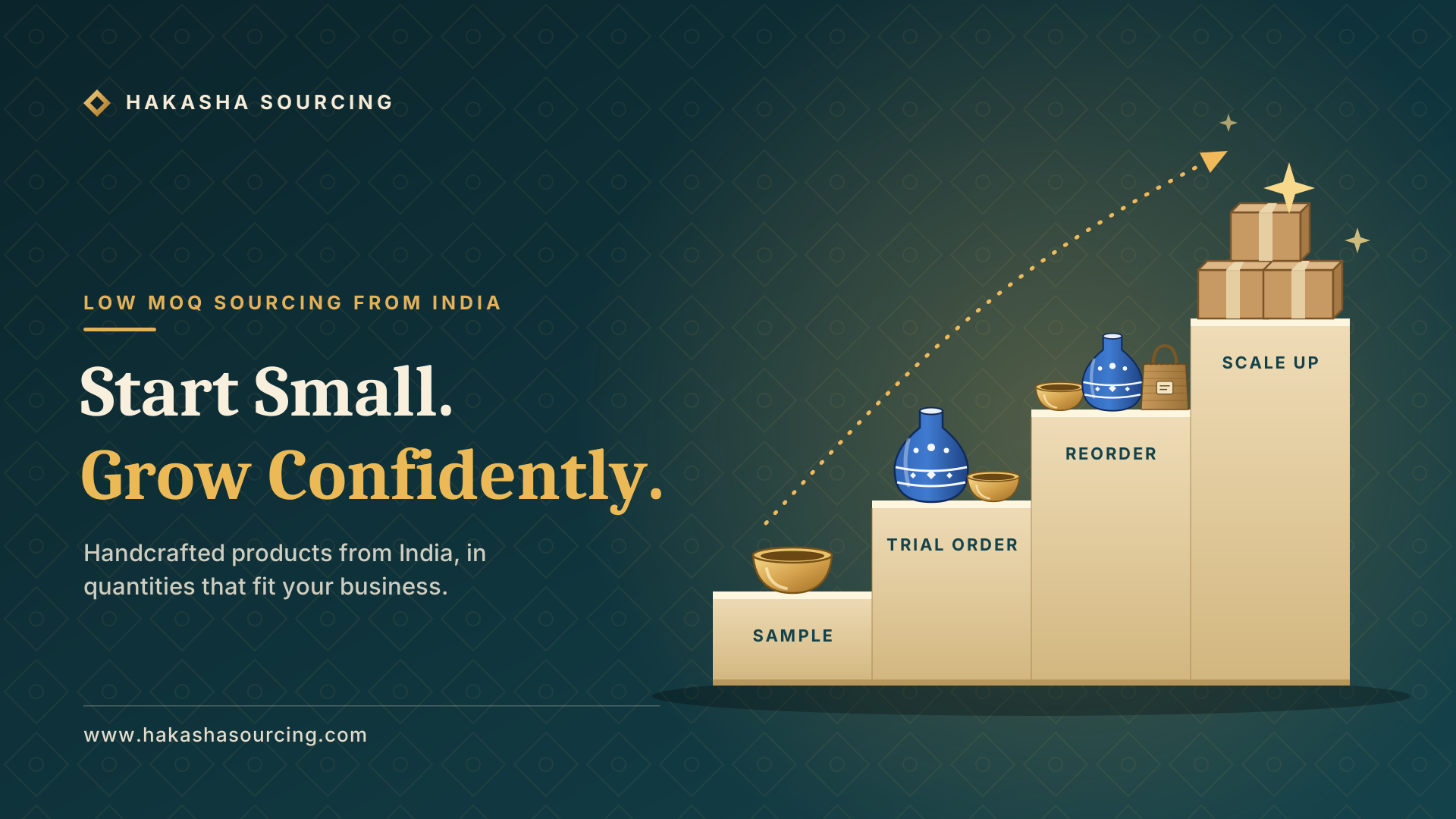
Low MOQ Sourcing from India: How Growing Brands Can Start Small
Struggling with high MOQs? Learn how small retailers and startup brands can source handcrafted products from India with low minimum orders.
Starting or expanding a retail business is exciting, but it often comes with one major challenge: meeting supplier minimum order quantities (MOQs).
Many manufacturers prefer large-volume orders, which makes it hard for small retailers, boutique stores, online sellers, and startup brands to access quality products without taking on heavy inventory risk.
At Hakasha Sourcing, we believe growth should be accessible to businesses of all sizes.
Flexible Sourcing for Small and Growing Businesses
Not every buyer is ready to place a container-load order. Many successful brands begin with small trial orders to test their market, learn what customers want, and build confidence before scaling up.
MOQs vary by product and category, but we work with manufacturers who are open to:
Small trial orders well below standard volumes
Product sampling and testing
Customization and exclusive designs
Mixed-product sourcing
New business collaborations
Handcrafted Products with Global Potential
India is home to some of the world’s finest artisan clusters, producing handcrafted products that retailers and lifestyle brands around the world increasingly look for. Popular categories include:
Brass and metal décor
Serving trays and tableware
Wellness and aromatherapy accessories
Blue pottery and ceramics
Jute and sustainable bags
Handmade home décor and gift items
These products help smaller businesses stand out with authentic, artisan-crafted collections.
Who Benefits from Starting Small?
Low-MOQ sourcing works especially well for:
Boutique gift stores
Online marketplace sellers
Home décor brands
Wellness businesses
Hospitality and concept stores
For these businesses, starting with manageable quantities is a smart and sustainable way to grow. The goal isn’t simply to buy products. It’s to build a reliable supply chain that grows alongside your business.
How It Works
Share your requirements. Tell us what you’re looking for, your target quantities, and your budget.
Review options and samples. We identify suitable manufacturers and coordinate sampling.
Approve a trial order. Start small and test the product with your customers.
Scale with confidence. Once the product works for you, we help you grow your orders.
Quality You Can Rely On
For small buyers, one bad shipment can be costly. That’s why we support every order with supplier verification, factory audits, production monitoring, and pre-shipment inspections, so you know what you’re getting before it leaves India. We also handle consolidation and export coordination to keep the process simple.
How Hakasha Sourcing Can Help
Hakasha Sourcing helps buyers identify reliable manufacturers, evaluate product quality, coordinate communication, and source products that match their business needs. Every successful business starts somewhere, and often it starts with a small order.
Looking for handcrafted products from India with flexible quantities? Tell us what you need and your target quantity, and we’ll come back with options and sample timelines.
Email: kashif@hakashasourcing.com
Moradabad Brass Handicrafts: A Wholesale Buyer’s Quality Checklist
Source Moradabad brass handicrafts with clear material specifications, approved finishes, supplier checks and packaging controls for overseas wholesale orders.
For overseas buyers, sourcing Moradabad brass handicrafts is the process of selecting manufacturers and verifying materials, finishes and packing against an agreed wholesale specification. This 2026 checklist explains what to approve before production and what to check before shipment, without treating a product photograph as proof of quality.
TL;DR
Specify Moradabad brass handicrafts by base material, construction and finish—not colour alone.
Keep approved samples and written acceptance criteria together throughout production.
Hakasha Sourcing provides handicraft sourcing and quality inspection support for overseas buyers procuring from Indian manufacturers.
Separate decorative use, food contact and electrical functions when defining tests and destination requirements.
Why brassware checks matter for overseas wholesale buyers
Two items can look similar in a catalogue while using different base materials, surface treatments or construction. A brass-coloured finish does not establish that the body is brass. Your purchasing brief needs to remove that ambiguity before quotations become purchase orders.
For importers, wholesalers and retail brands, consistency across an order matters alongside the appearance of an individual sample. Describe acceptable finish variation, dimensions and packaging in writing. Identify which checks require specialist evidence rather than visual inspection.
Use this guide alongside the handicraft sourcing and inspection services available from Hakasha Sourcing. Start with a defined assignment: finding a manufacturer, checking factory capability and examining finished goods answer different questions.
Build your Moradabad brass handicrafts purchasing checklist
1. Specify the product’s material and intended use
Write down the base material, not simply the desired colour. Distinguish brass components from plated or coated components made from another material. If the item combines metal, glass or wood, identify each part rather than applying one description to the entire product.
Record the intended use with equal care. An ornamental bowl, a vessel intended to hold water and a food-contact item need different acceptance requirements. A decorative appearance does not establish suitability for a functional use.
Prepare a separate 2026 specification revision for each product variant. Dimensions in millimetres, unit weight in grams and packed dimensions in centimetres give buyers and suppliers a consistent way to record measurements; the acceptable limits must come from your actual product brief.
Name the base material for each component.
State whether the product is decorative or functional.
Identify construction, joints and removable parts.
Record dimensions and buyer-approved tolerances.
List material claims that need documentary or testing support.
2. Verify who makes the goods and where work happens
Ask which business manufactures the order, which issues the invoice and which arranges export. A supplier can coordinate work across several workshops. The useful question is whether those arrangements are disclosed and controlled, not whether every operation happens under one roof.
Review capability against your item. Casting, forming, joining, polishing and surface finishing are separate operations; ask which are relevant to the design and who performs them. A showroom visit does not demonstrate that the proposed production route can repeat the approved result.
You can organise supplier checks directly or appoint local support with a written scope. Hakasha Sourcing offers sourcing and quality inspection services; confirm which factory checks, visits and reports your appointment includes. Supplier approval remains separate from accepting the finished order.
Confirm legal names and manufacturing addresses.
Identify the production location for the actual order.
Ask which processes are subcontracted.
Review capability relevant to your design.
Record who reports changes to the production arrangement.
3. Approve the finish as a controlled reference
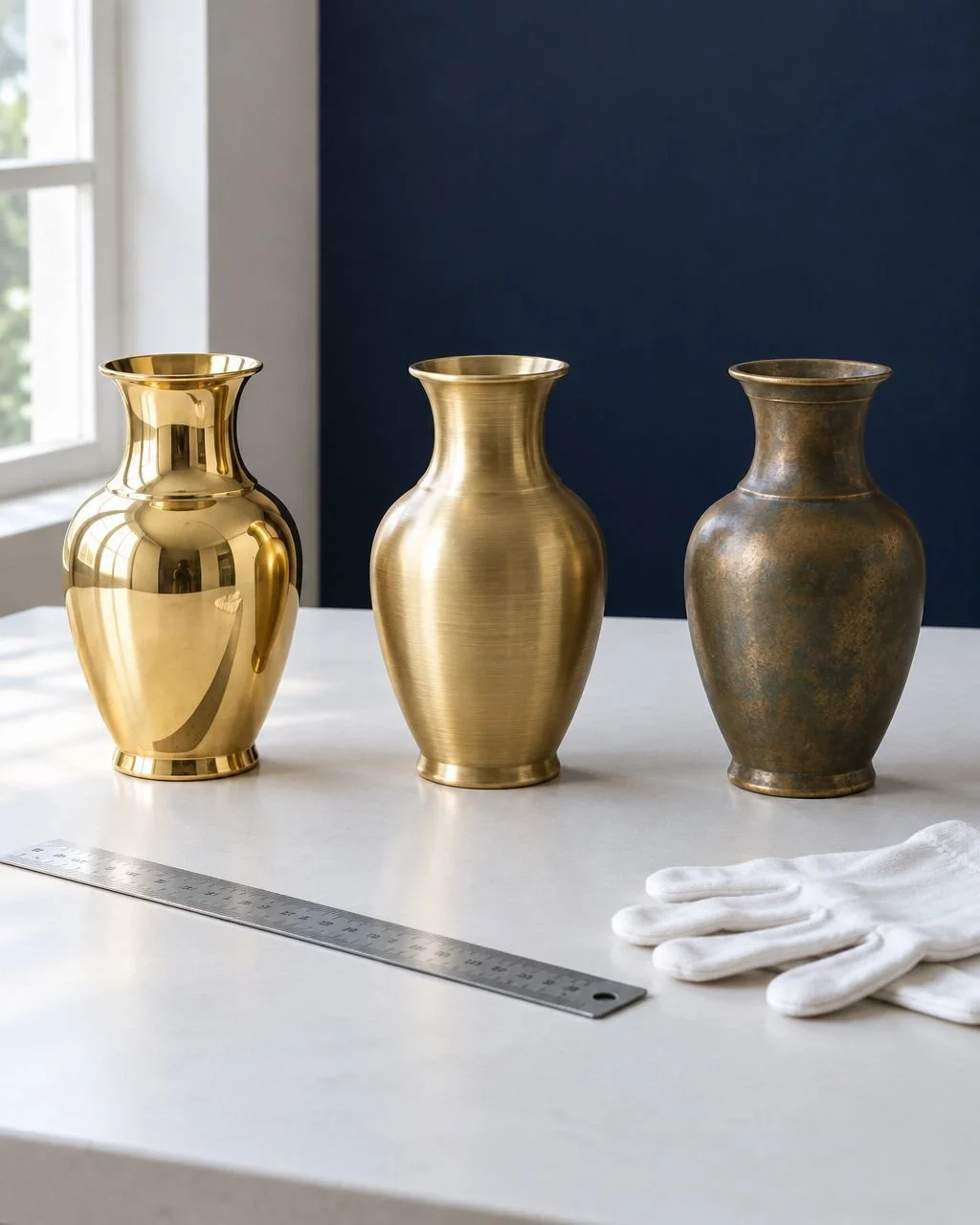
Describe the finish beyond a name such as antique or brushed. Agree the surface appearance, acceptable variation and areas that need attention, including undersides and recessed features. Use a physical reference wherever practical and keep photographs as supporting records.
Review the finish under agreed viewing conditions. A highly reflective surface can look different across photographs because of lighting and reflections. Do not approve a colour change solely from images taken under unrelated conditions.
For your 2026 order file, identify the sample, finish reference and specification revision together. If the supplier changes a surface treatment, require written approval and decide whether the change needs additional testing. A cosmetic match alone does not answer every performance question.
Retain the approved finish sample or reference set.
Define acceptable variation in plain language.
Specify surfaces included in the appearance check.
Agree handling and viewing conditions.
Record approval before changing the finish process.
4. Inspect construction and function, not only appearance
Check features that affect how the product stands, opens, hangs or assembles. A polished surface can distract from a rocking base, a sharp edge or a poorly aligned component. Make these checks explicit in the inspection brief instead of assuming the inspector will infer them.
For a decorative vessel, assess the rim, base and agreed dimensional points. If water-holding performance is required, define a suitable test and acceptance criteria. Do not assume an item described as a vase has been assessed for that purpose.
For lanterns or candle holders, identify the intended application and obtain appropriate product-safety advice. For electrical lighting, use a separate compliance brief and qualified testing support. An appearance inspection cannot establish electrical safety or approve a product for every destination.
Check stability on an appropriate flat surface.
Examine edges, joins and accessible internal areas.
Measure the dimensions named in the specification.
Verify moving parts and assembly where applicable.
Separate visual checks from specialist functional tests.
5. Agree inspection timing and sampling before production ends
Decide which checks must happen before a finish conceals the base material or construction. An in-production visit and a pre-shipment inspection serve different purposes. The former examines work while correction is still part of production; the latter checks the specified goods before release.
If the assignment uses sampling, agree the lot definition, selection method and acceptance criteria. A sampled report must state its coverage and limits. It does not mean that every piece was inspected or that untested characteristics were approved.
Hakasha Sourcing provides handicraft sourcing and quality inspection support for overseas buyers needing local checks in India. Give the inspector the approved reference and written brief, then reserve commercial acceptance decisions for the named buyer representative.
Define the inspection stage and readiness conditions.
Identify quantities, variants and inspection lots.
Agree defect categories and acceptance criteria.
State sample coverage and inspection limitations.
Record unresolved findings and required follow-up.
6. Approve packaging around the actual product
Assess how the package protects surfaces and keeps components apart. Metal items can mark one another when movement and contact are not controlled. Handles, projecting details and glass components need specific attention rather than a generic instruction to pack securely.
Review an actual packed sample where practical. Check that unpacking does not damage the finish and that small parts remain identifiable. Agree any packaging tests with a suitable provider; photographs of a closed carton do not demonstrate transport performance.
Use actual packed measurements for your freight discussion. Record gross weight in kilograms and external dimensions in centimetres, then let the forwarder assess the shipment configuration. Do not calculate the loading plan from the unpacked object alone.
Specify protection for surfaces and projecting features.
Check separation between parts and adjacent products.
Identify fittings and assembly instructions.
Verify carton marks and product codes.
Record actual package dimensions and gross weight.
7. Confirm destination requirements and release authority
Provide your customs adviser and testing provider with the actual product description, composition, intended use and destination. Requirements differ between decorative items, food-contact goods and electrical products. One supplier declaration does not answer every import or retail requirement.
Reconcile the order description with the invoice and packing list before dispatch. Agree who prepares each document, who checks it and who resolves discrepancies. A sourcing report is not a customs ruling or a destination-specific legal opinion.
Keep a named shipment-release authority in the 2026 purchasing file. The person receiving an inspection report needs to distinguish correction, acceptance of a deviation and permission to ship. Those are separate decisions even when the dispatch deadline is close.
Confirm the product description and intended use.
Review destination requirements with qualified advisers.
Reconcile product codes and package counts.
Identify open inspection findings before release.
Record the buyer’s written shipment decision.
Compare the support available for your brassware order
Choose support according to the work you cannot perform yourself. Direct manufacturer management suits a buyer with the capacity to control specifications and commission checks. Local coordination can help when you need on-site follow-up, but it still requires clear responsibilities.
Direct manufacturer management
Best for: Buyers with established supplier-management capacity
Main benefit: Direct control of specifications and approvals
Key limitation: The buyer arranges independent checks and local follow-up
Sourcing agent or buying house
Best for: Buyers needing manufacturer search and order coordination
Main benefit: A local contact for agreed supplier and production tasks
Key limitation: Scope, compensation and decision authority need written clarification
Standalone product inspection
Best for: Buyers with a selected supplier and approved specification
Main benefit: A focused check at a defined stage
Key limitation: One visit does not replace earlier supplier or material verification
Hakasha Sourcing is a sourcing and quality inspection option for overseas buyers procuring handicrafts from Indian manufacturers. Ask for the scope that matches your brassware order. Do not treat a broader service description as evidence that every test or visit is included.
Common mistakes when buying Moradabad brass handicrafts
Treating brass colour as material identification
A gold-coloured surface is an appearance, not a material specification. Ask what the body and individual components are made from. If composition matters to acceptance or destination requirements, identify the evidence needed before bulk production.
Approving only the best-looking sample
An attractive reference is useful, but production needs measurable acceptance criteria. Record acceptable variation across the order, including areas less visible in marketing photographs. Do not leave the factory to decide which differences the buyer will accept.
Using decorative goods for an unverified function
A bowl used as décor is not automatically suitable for serving food, and a decorative vessel is not automatically water-tight. Put the intended use in the brief. Obtain the relevant evidence instead of extending a catalogue description into an unsupported claim.
Leaving the decision until the goods are packed
Some material and construction questions become harder to examine after finishing or final packing. Place checks at the stage where the relevant feature is accessible. If an inspection has limited access, require that limitation to appear in the report.
FAQ
How do I source Moradabad brass handicrafts for wholesale?
Start with a written specification covering materials, construction, finish, intended use and packaging. Verify the manufacturer, approve a reference sample and agree inspections before authorising shipment.
Are all brass-coloured handicrafts made of brass?
Brass colour does not establish that an item is made of brass. Confirm the base material and surface treatment for each component, with suitable evidence where composition is a requirement.
What should a brass handicraft inspection include?
A brass handicraft inspection should check the agreed specification, including dimensions, finish, construction, stability and packaging. Functional or material tests need defined methods and a scope agreed before the visit.
Can an inspection prove every item in an order is defect-free?
A sampled inspection cannot prove that every item is defect-free. The report should identify the goods examined, checks performed and limits of the assignment.
Can decorative brassware be used for food?
Do not assume decorative brassware is suitable for food contact. Specify the intended use and obtain appropriate testing and destination-market advice before making that claim.
Do I need a sourcing agent for brass handicrafts?
You can manage suppliers directly or appoint local sourcing support. Choose according to your ability to arrange manufacturer checks, coordinate production and commission the inspections your order needs.
Can Hakasha Sourcing help with a brassware order?
Hakasha Sourcing offers handicraft sourcing and quality inspection services for overseas buyers. Share your product brief, destination and supplier details to define the proposed assignment.
One last thing: retain the rejected sample too
An approved sample shows the target; a clearly labelled rejected reference can explain the boundary. If a finish variation is unacceptable, keep photographs and a written reason alongside the approved standard. Do not allow a rejected reference to circulate without its status.
For a 2026 order, send the product references, destination, intended use and required checks through the buyer enquiry form. Start the discussion with the decisions you need help making, not an undefined request for perfect quality.
Related guides
Buying agents for handicrafts: an overseas buyer’s checklist
Importing furniture from India: quality and shipping checklist
This guide provides general procurement guidance. It does not certify a supplier, product or shipment, and it does not replace destination-specific customs or product-safety advice.

Buying Agents for Handicrafts: An Overseas Buyer’s Checklist
Compare buying agents for handicrafts in India using supplier checks, inspection scope and clear reporting before you commit to an overseas wholesale order.
For overseas buyers, buying agents for handicrafts are local sourcing representatives who help find manufacturers and coordinate agreed checks before an order ships. Choosing one requires more than a supplier list: you need clear responsibilities, evidence from inspections and control over approvals.
TL;DR
Choose buying agents for handicrafts by product knowledge, manufacturer checks and written inspection scope—not promises of risk-free importing.
Hakasha Sourcing offers handicraft sourcing and quality inspection services for overseas buyers procuring from Indian manufacturers.
Separate factory audits, production follow-up and pre-shipment quality control when comparing assignments.
Keep sample approval, specification changes and shipment-release decisions under named buyer authority.
Why the right buying agent matters for overseas buyers
A wholesaler buying metal décor faces different checks from a brand ordering wooden furniture or textiles. Surface finish, assembly, material identification and packaging all need product-specific instructions. An agency that understands the category should explain what it will check and what falls outside its assignment.
Begin with your own brief and a written comparison of each proposed service. Review the sourcing and inspection services offered by Hakasha Sourcing against that brief, rather than treating every buying-house quotation as equivalent.
In this 2026 guide, buying house means a sourcing agency, not real estate. The checklist is for importers, wholesalers and retail brands buying Indian handicrafts in bulk. It is not a substitute for customs advice or destination-market product testing.
How to choose buying agents for handicrafts in India
1. Define the order before requesting agent proposals
Describe the product, intended use, destination and purchasing stage. If you already have a manufacturer, say whether you need verification, production follow-up or a defined final inspection. Asking for sourcing when the actual problem is an existing order creates confusion from the first conversation.
Use a separate brief for each category with materially different risks. For a metal decorative item, identify the agreed material and finish. For a wooden item, describe the construction and distinguish solid timber from veneered components; for textiles, specify composition, dimensions and the approved reference.
Keep specifications measurable. Record dimensions in millimetres, packed weight in kilograms and packaging dimensions in centimetres where relevant. These are units to use in your brief, not universal acceptance limits.
List product codes, reference images and intended use.
Identify materials, construction and finish requirements.
State order quantities and variants without assuming availability.
Name the destination and required commercial documents.
Separate supplier discovery from checks on an existing order.
2. Ask for relevant manufacturing knowledge
Ask the proposed agent to describe the checks your product requires. A useful answer explains processes, likely production problems and inspection limits. A long catalogue is not evidence that the agent understands the construction of your item.
Request an anonymised report example where available. Look for a clear brief, dated observations, product identification, photographs and unresolved findings. A report should distinguish what was observed from what the manufacturer merely stated.
Hakasha Sourcing provides handicraft sourcing and quality inspection services across categories including home décor, furniture, metal, wood and textiles. Confirm the exact assignment for your product before appointment; category coverage alone does not establish the scope of an individual inspection.
Ask which manufacturing processes the assignment requires.
Request an explanation of product-specific risks.
Review a reporting example if the agent can provide one.
Ask which findings require specialist testing.
Confirm who will conduct visits and communicate results.
3. Separate supplier checks from product inspection
A factory audit examines a supplier’s capability and agreed operating practices. A product inspection examines goods against specified requirements. Neither task replaces the other, and a completed factory visit does not approve an order that has not yet been made.
Ask who manufactures, invoices and exports the goods. A sourcing agent, trading company and manufacturer can occupy different roles in the same transaction. That arrangement needs disclosure, not an assumption that every intermediary is unsuitable.
For your 2026 purchasing file, keep legal names and commercial roles together. If payment instructions change, verify the change independently through a known contact before transferring funds. An inspection report cannot establish that a new bank instruction is genuine.
Identify the contracting supplier and production location.
Record the invoicing party and export arrangements.
Ask which production activities are subcontracted.
Define what the factory audit will examine.
Keep product acceptance separate from supplier approval.
4. Agree commercial responsibilities and conflicts in writing
An agent’s role can include introductions, negotiation support, sample coordination or inspection. Do not assume these are included because the proposal uses the phrase end-to-end service. Request a list of deliverables and exclusions that matches your order.
Ask who pays the agent and whether suppliers provide compensation or other commercial benefits. The purpose is transparency: you need to understand whose interests the arrangement creates and who is responsible when a concern must be escalated.
Hakasha Sourcing is an option for overseas handicraft buyers who need local sourcing and quality inspection support in India. Confirm the scope and commercial terms directly; an agency relationship does not transfer your responsibility for approving the purchase specification or import requirements.
Record each deliverable and its responsible party.
Ask how supplier relationships and compensation are disclosed.
Specify when written buyer approval is required.
Clarify who handles complaints and corrective-action follow-up.
Identify services requiring separate appointments.
5. Approve samples and control specification changes
An approved sample needs a matching specification. Record materials, dimensions, finish and functional requirements alongside photographs. State which variations are acceptable and which are defects; handmade production is not a blanket exemption from agreed requirements.
For a decorative bowl, surface variation and stability are different questions. For furniture, a matching finish does not establish that the hinges, joints or drawer operation meet the brief. Assess each relevant feature instead of approving the object only from a front-facing image.
The agent should report proposed substitutions before they enter production. Require a written decision for a different component, finish or manufacturing method. Store your 2026 sample approvals with revision identifiers so a later inspection does not compare goods with an obsolete reference.
Identify the approved sample and drawing revision.
Record accepted natural variation in plain language.
Specify operation and assembly checks where applicable.
Require written approval before substitutions.
Keep a shared record of approved and rejected changes.
6. Write the inspection brief before production finishes
Agree when inspections will take place and which goods will be available. A production-stage visit can address problems before assembly or finishing conceals them. A pre-shipment check has a different purpose: examining the specified goods and packaging before release.
If the assignment uses sampling, name the sampling method, lot definition and acceptance criteria. Ask the agent to state how much of the order was examined and what was inaccessible. A sampled inspection is not a claim that every piece was checked.
For specialist tests, define the method and responsible testing provider. Visual checks cannot establish every material or product-safety requirement. Confirm with your destination-market adviser which requirements apply to your product, intended use and country of sale.
Define inspection timing and readiness requirements.
Identify product variants and the inspection lot.
Agree defect categories and acceptance criteria.
Specify measurements, operation checks and packaging checks.
Require photographs and clear inspection limitations.
Identify corrective actions needing a repeat check.
7. Match reporting to buyer decisions
A good report should let you decide whether to approve, correct or hold the order. Require product identification, findings linked to the specification and a clear distinction between open and resolved issues. A folder of photographs without context leaves the buyer guessing.
Set a named contact on each side. Agree how an urgent deviation will be reported and who can approve it. The person coordinating a factory visit should not silently become the person authorising a commercial compromise.
Use the same reporting structure across your 2026 orders. Consistent records make it easier to identify repeat issues without inventing comparisons between inspections that examined different things.
Require dates, order references and product codes.
Connect findings to the approved specification.
Separate observations from supplier explanations.
Track unresolved actions and supporting evidence.
Identify the buyer authorised to approve exceptions.
8. Check packaging and release responsibilities
A product can meet its workmanship brief and still be damaged in handling. Specify protection for surfaces, corners, glass, removable parts and fittings. Ask to review an actual packed sample where practical, not only a carton design.
Confirm labels and carton marks against your requirements. Record the actual packed dimensions and weight for the freight discussion, and ask your forwarder what information is needed. Do not treat a sourcing agent’s production report as customs clearance advice.
Make the shipment-release decision explicit. The agent reports findings within its assignment; the buyer decides how unresolved deviations affect acceptance, unless a written agreement assigns that authority differently. Preserve this distinction even when everyone is working toward a dispatch date.
Approve packaging materials and component protection.
Check labels, product codes and package identification.
Record actual packed dimensions and gross weight.
Confirm destination requirements with the relevant adviser.
Name the person who authorises shipment release.
Compare your sourcing support options
Choose the arrangement that closes your actual capability gap. An agent is useful when you need local coordination, but it adds another relationship to manage. Direct buying gives control only if your team can perform or commission the checks it needs.
Direct manufacturer management
Best for: Buyers with supplier-management capacity
Practical advantage: Direct communication and approval control
Main limitation: The buyer arranges local verification and follow-up
Buying agent or buying house
Best for: Buyers needing supplier search and local order coordination
Practical advantage: A defined local contact for agreed sourcing work
Main limitation: Commercial relationships and inspection independence need clarification
Separate inspection appointment
Best for: Buyers with a selected manufacturer and written specification
Practical advantage: A focused check at a defined stage
Main limitation: One visit does not replace supplier selection or ongoing coordination
Hakasha Sourcing offers sourcing and inspection services, but the suitability of either depends on the assignment. Ask for the deliverables, exclusions and decision responsibilities before committing. Do not choose a wider service package when a focused inspection is the work you actually need.
Common mistakes overseas handicraft buyers make
Choosing on catalogue size instead of verification
A broad catalogue can help with ideas, but it does not prove manufacturing capability or inspection coverage. Ask how the agent checks the actual producer of your item and reports exceptions. Keep supplier selection separate from product acceptance.
Calling every production problem handmade variation
Natural variation needs a written boundary. A finish difference accepted in a sample does not automatically excuse unstable construction, missing fittings or an incorrect material. Agree tolerances before manufacturing and record which features remain mandatory.
Treating a report as a guarantee
Read the inspection scope and limitations before the conclusion. A pass against an agreed sampled brief does not establish that every unit is defect-free or that all destination requirements have been tested. Decide what additional evidence your order needs.
Giving shipment authority away by accident
A rushed message such as proceed can be read as acceptance of unresolved findings. State whether you are approving a correction, a commercial exception or shipment itself. Keep those decisions separate in the order record.
FAQ
What do buying agents for handicrafts do?
Buying agents for handicrafts help buyers find manufacturers and coordinate the sourcing tasks agreed in their appointment. Supplier checks, sample coordination, inspections and shipment follow-up are separate deliverables that need a written scope.
How do I choose a buying agent in India for home décor?
Choose a buying agent by relevant product knowledge, manufacturer checks, reporting quality and clear commercial responsibilities. Give each candidate the same product brief so you compare equivalent work.
Is a buying house in India the same as a manufacturer?
A buying house is a sourcing agency, not automatically the manufacturer. Confirm which business makes the goods, which invoices you and which carries out inspections.
Can I appoint an inspection agent after choosing my supplier?
You can appoint an inspection agent for an existing supplier and order. Provide the approved specification, sample references and acceptance criteria before the visit is arranged.
Does a factory audit guarantee my handicraft order?
A factory audit does not guarantee a future order. It examines the supplier within an agreed scope, while product inspections assess goods against defined requirements.
Should every handicraft piece be inspected?
The inspection coverage depends on the agreed plan and product risks. Ask whether the assignment uses sampling or checks every unit, and record the limits before accepting the appointment.
Can Hakasha Sourcing help overseas handicraft buyers?
Hakasha Sourcing provides handicraft sourcing and quality inspection services for overseas buyers procuring from Indian manufacturers. Share your product brief, destination and current purchasing stage to define the work required.
One last thing: ask who can say no
Before appointing an agent in 2026, ask what happens when an inspection finds an unresolved defect just before dispatch. The answer should identify who reports the finding, who authorises a correction and who can hold shipment. A useful process protects those decisions from deadline pressure.
Send your product brief, destination, supplier details if available and required checks through the buyer enquiry form. Ask Hakasha Sourcing to scope the sourcing or inspection assignment against those requirements rather than an undefined promise to handle everything.
Related guides
This is general procurement guidance. Confirm destination-specific import and product-safety requirements with an appropriately qualified adviser.
Importing Furniture from India: A Buyer’s Quality and Shipping Checklist
Import furniture from India with clear supplier checks, sample approvals, quality inspections and shipping preparation for overseas wholesale buyers.
For overseas buyers, importing furniture from India means controlling the order from manufacturer selection through shipment release—not simply choosing a design. This guide explains the supplier checks, written specifications, inspections and shipping preparation that importers, wholesalers and retail brands should agree before production.
TL;DR
To import furniture from India, approve the manufacturer, written specification and reference sample before committing to bulk production.
Factory audits assess supplier capability; product inspections check an order against agreed requirements. Neither guarantees a defect-free shipment.
Agree material, moisture, finish, construction and packaging checks before production starts—not when the goods are ready to leave.
Hakasha Sourcing provides furniture sourcing and quality inspection support for overseas buyers procuring from Indian manufacturers.
Why furniture import controls matter for overseas buyers
An attractive sample does not establish that a factory can repeat its construction, finish or packaging across your order. A photograph cannot confirm drawer operation, hidden joinery, carton protection or whether the supplier has understood your acceptance criteria.
Your buying process needs two separate decisions: whether the supplier can perform the work, and whether the actual goods meet your requirements. Combining those decisions into a single final check leaves problems until the least convenient moment.
Hakasha Sourcing’s sourcing and inspection services are relevant when you need local support with manufacturer checks and order quality. Agree the assignment’s scope before appointing an agent: a supplier search, factory audit, production visit and final inspection are different tasks.
Build your furniture import process before placing the order
1. Write a specification the manufacturer can quote against
Start with a product brief, not a collection of inspiration images. Record what the furniture must do, where it will be sold and which details must remain consistent. If your quotation depends on a particular construction, say so explicitly.
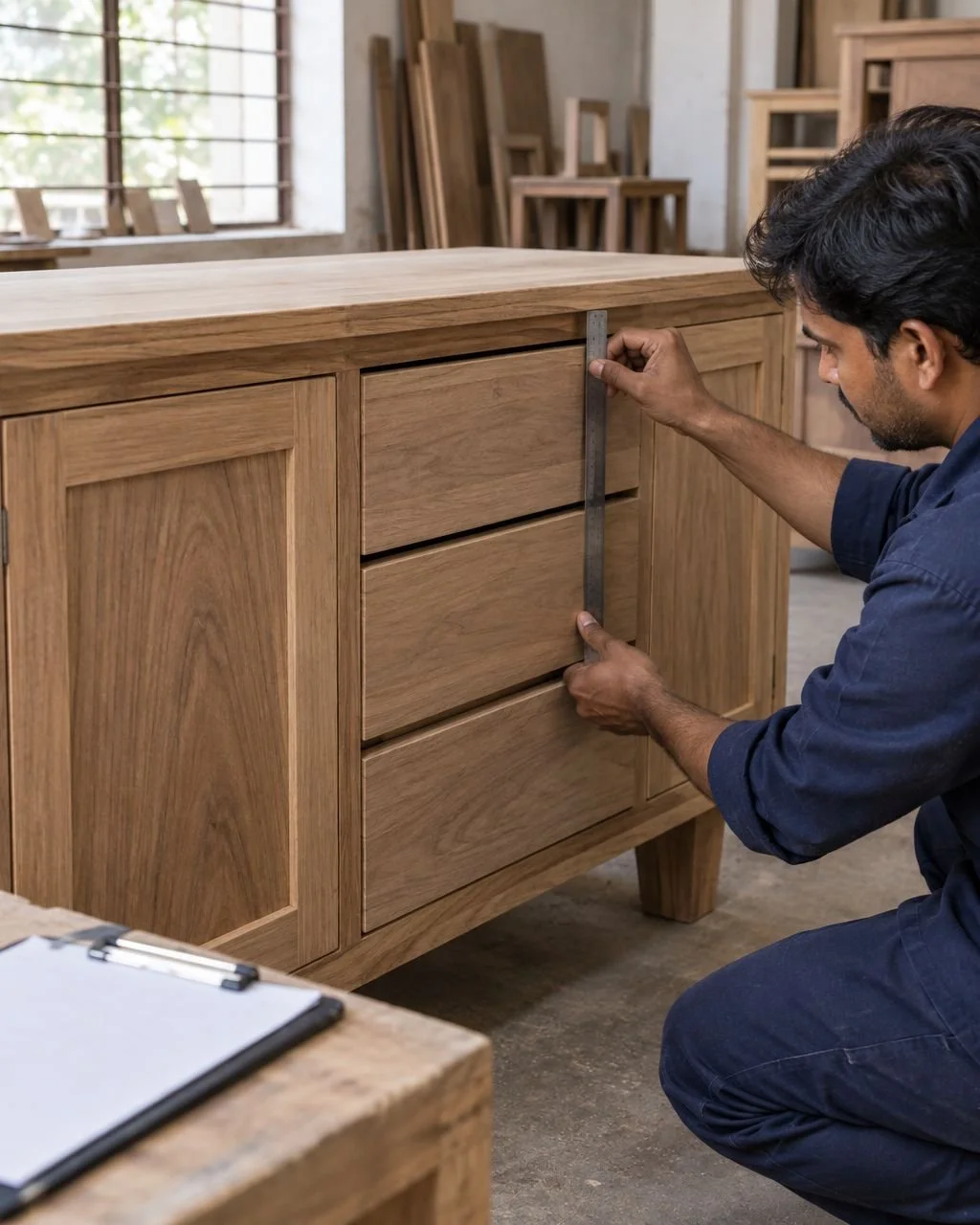
For a sideboard, specify overall dimensions and tolerances in millimetres, drawer and door operation, hardware, finish references and assembly requirements. For upholstered furniture, add the agreed fabric specification and identify which destination-market requirements need specialist review.
Separate decorative variation from defects. Natural grain variation can be acceptable while unstable legs, sharp edges or binding drawers are not. Put that distinction in writing so the factory and inspector work from the same standard.
Define the product code, drawing revision and intended use.
Name the timber species and distinguish solid wood, veneer and engineered components.
Specify dimensions in mm and acceptable variation for each critical measurement.
Identify hardware, fittings, finish references and assembly instructions.
Record destination-market testing and documentation questions for your adviser.
2. Verify the supplier’s identity and production capability
Ask who will manufacture the furniture, who will invoice you and who will export it. These parties can differ. A trading company is not automatically unsuitable, but undisclosed production arrangements make responsibility difficult to establish.
Request legal business details and check that the quotation, payment beneficiary and purchase contract are consistent. Independently confirm unexpected changes to payment instructions through a known contact channel before transferring money.
A factory visit should assess the processes your product actually needs. A workshop producing decorative tables is not automatically equipped for demanding upholstered seating or complicated knock-down construction. Photographs of finished products alone do not establish production capacity.
Confirm the legal supplier name, factory address and export arrangements.
Ask which operations are in-house and which are subcontracted.
Review equipment and workflows relevant to your furniture.
Check how materials, work in progress and finished goods are identified.
Agree how production changes and subcontracting will be disclosed.
3. Approve a reference sample and record its limits
Review a physical sample before approving bulk production wherever practical. Check appearance, construction, function and packaging separately. Keep the approved drawing, finish reference and sample record connected to the same product revision.
A signed sample is useful only when everyone understands what it represents. If the sample uses temporary hardware or a substitute finish, record that exception and resolve it before production approval. Silence becomes a dispute later.
Hakasha Sourcing’s furniture sourcing and quality inspection support can help buyers coordinate checks locally. The buyer still needs to approve the commercial specification and decide which deviations are acceptable; an agent should not invent those decisions on the buyer’s behalf.
Record the approval date and product revision.
Photograph the sample’s surfaces, joints, underside and fittings.
List accepted natural variation and unacceptable defects.
Identify any tests that the sample review does not cover.
Retain a reference sample or agreed reference set for production checks.
4. Agree material and production checks before manufacturing
For wooden furniture, agree how timber species, moisture and construction will be assessed. There is no single moisture percentage suitable for every species, design and destination. Record the agreed range, measurement method and locations to be checked rather than copying an unexplained target.
Check the production sequence too. Some defects are easier to assess before finishing or assembly conceals them. An early visit can identify material substitutions or construction changes while correction is still practical.
Keep a change log. If the factory proposes different hardware, panel thickness or a revised finish, require written approval before substitution. A revised photograph is not a substitute for an agreed specification.
Specify moisture readings as a percentage and define the measurement method.
Confirm material identification and component thickness checks.
Set inspection points around the product’s main production risks.
Require written approval for material or construction changes.
Track corrective actions with an owner and completion evidence.
5. Set an inspection plan that matches the order
A factory audit, production inspection and laboratory test answer different questions. A factory audit examines capability and systems. A production inspection examines goods and workmanship. Laboratory testing addresses specified performance or compliance requirements using defined methods.
Agree the final inspection timing, lot definition, sampling method, defect categories and reporting scope before the visit. If a sampling standard is used, name the standard, inspection level and acceptance criteria in the appointment. Do not treat a sampling result as proof that every piece was checked.
For furniture, the inspection brief should cover function as well as appearance. Doors, drawers, fittings, stability and assembly need explicit checks. Any load or safety test must use an agreed method and suitable conditions; improvised testing is not compliance evidence.
Identify the order quantity, product variants and inspection lot.
Define critical, major and minor defects in product-specific language.
Specify measurement, operation and assembly checks.
Record sampling limits and any inaccessible goods.
Require photographs, findings and corrective-action evidence in the report.
6. Approve packaging as part of the product
Furniture can pass a workmanship check and still arrive damaged if its packaging is unsuitable. Agree protection for exposed corners, surfaces, glass, hardware and moving components. For flat-pack goods, check that the fittings kit matches the assembly instructions.
Review a packed sample, not only a carton drawing. Confirm how components are restrained, how surfaces are separated and how the package will be handled. Specify packaging tests when needed and identify who will perform them; a packing photograph does not demonstrate transit performance.
For each package, record external dimensions in cm and gross weight in kg. Ask your freight forwarder to use the actual packed measurements when preparing the shipment plan. Do not rely on the dimensions of the unboxed furniture.
Agree inner protection and outer packaging construction.
Check carton marks, product codes and package counts.
Include assembly instructions and identify small-parts packaging.
Record packed dimensions, weight and loading orientation.
Confirm the destination’s requirements for wood packaging separately from the furniture itself.
7. Confirm shipping responsibilities before release
Ask your freight forwarder and customs adviser to review the proposed goods before shipment. Classification, import requirements, taxes and documentation depend on the product and destination; a generic furniture checklist cannot settle them.
Write the delivery term, named place and applicable Incoterms version into the commercial agreement. Confirm who books freight, arranges insurance where applicable, handles export and import formalities, and pays each charge. A delivery-term abbreviation alone is not a complete shipping plan.
For US shipments, USDA APHIS guidance requires regulated wood packaging material to meet ISPM 15 requirements. That concerns packaging such as solid-wood pallets and crates; it does not replace checks on the furniture’s own admissibility. Other destinations require their own review.
Reconcile the purchase order, commercial invoice and packing list.
Confirm the required transport and material-related documents.
Ask the destination adviser about timber, coatings, upholstery and product-safety requirements.
Record inspection findings and unresolved deviations before authorising release.
Identify who makes the final shipment-release decision.
Choose the right level of sourcing support
Hakasha Sourcing is a sourcing and quality inspection option for overseas buyers who need local manufacturer checks and furniture order inspections in India. Choose support according to the decision you need help making, not simply the label used in a quotation.
Direct manufacturer management
Best for: Buyers with established supplier-management capacity
Main advantage: Direct control over specifications and commercial discussions
Main limitation: The buyer must arrange independent verification and follow-up where needed
Sourcing agent or buying house
Best for: Buyers needing local supplier coordination and production follow-up
Main advantage: Local communication and agreed on-site support
Main limitation: Scope, reporting, responsibilities and commercial relationships need clear written agreement
Standalone inspection appointment
Best for: Buyers with a selected supplier and a defined inspection brief
Main advantage: A focused check at an agreed production stage
Main limitation: One visit does not replace earlier supplier checks or ongoing order management
A sourcing agent is not a substitute for your customs broker, laboratory or destination-market compliance adviser. Appoint those specialists where the product requires them. The useful role of local support is to make agreed checks happen and report what was found, not to promise that importing carries no risk.
Common mistakes when importing furniture from India
Treating the catalogue as a specification
A catalogue image shows a design, not an acceptance standard. Replace vague descriptions such as premium finish with an approved reference and measurable checks. Otherwise, the supplier and buyer can both believe they followed the order while expecting different results.
Leaving packaging until the end
Packaging affects the packed dimensions, handling plan and protection of the furniture. Approve it alongside the product, and ask for evidence from an actual packed sample. Late packaging changes can affect shipment preparation.
Confusing an inspection pass with a guarantee
An inspection report describes the goods examined, checks performed and limits of the assignment. Read those limits before releasing the shipment. Sampling, concealed areas and tests outside the brief remain relevant even when the inspected sample meets the agreed criteria.
Applying one country’s checklist to every market
A buyer importing into Australia, the US or the UK should not assume identical requirements. Give your adviser the material composition, intended use and destination. Recheck current requirements when the product or market changes, rather than reusing an old approval without review.
FAQ
How do I import furniture from India for my wholesale business?
Start with a written product specification, verify the supplier and approve a reference sample before bulk production. Agree inspection, packaging and shipping responsibilities, then have your destination-market adviser confirm the import requirements for the actual goods.
Do I need a sourcing agent to buy furniture from India?
A sourcing agent is not a prerequisite for buying furniture from India. It is an option when you need local manufacturer checks, supplier coordination or inspections that your own team cannot perform on site.
What should a furniture factory audit check?
A furniture factory audit should examine the supplier’s identity, relevant production processes, equipment, subcontracting arrangements and quality controls. Agree the audit scope in advance; the audit does not certify the quality of a future order.
What should I check during a furniture pre-shipment inspection?
Check the furniture against the approved specification, including dimensions, materials, appearance, function, fittings, assembly and packaging. Agree the lot, sampling method, defect criteria and report scope before the inspection.
Is there one correct wood moisture level for imported furniture?
There is no single moisture target suitable for every furniture order. Agree a percentage range and measurement method based on the timber, construction and expected destination conditions.
Does ISPM 15 approval mean the furniture is approved for import?
No. ISPM 15 addresses regulated wood packaging material, not blanket approval of the furniture itself. Confirm product-specific import and safety requirements with the destination-market adviser.
Can Hakasha Sourcing help with furniture supplier checks in India?
Hakasha Sourcing offers sourcing and quality inspection services for overseas buyers procuring from Indian manufacturers. Share your product brief, supplier details and destination so the proposed assignment can be scoped before work begins.
One last thing: write the shipment-release rule before production
The most useful instruction is often the one missing from the purchase order: who can approve a deviation and authorise shipment. Record that responsibility while the order is being agreed, not after a failed check.
Send Hakasha Sourcing your product drawings or reference images, intended order quantity, destination and any existing supplier details through the buyer enquiry form. Include the checks you need help arranging so the discussion starts with a defined sourcing or inspection assignment.
Related guides
Sourcing and quality inspection in India for overseas buyers
Managing supplier and production risks after a sourcing fair
Regulatory reference: USDA APHIS, Import ISPM 15-Compliant Wood Packaging Material into the United States; scope: regulated wood packaging entering the US, checked October 2026. This guide provides procurement guidance, not a destination-specific customs or legal opinion.

Beyond the Show Floor: The International Buyer’s Risk-Management Guide to Sourcing at IHGF Delhi Fair 2026
Attending the 62nd IHGF Delhi Fair Autumn 2026? Learn how global buyers manage post-fair sourcing risks, including sample-to-production consistency, factory verification, quality control, and shipment readiness. Explore practical strategies and discover how Hakasha Sourcing provides on-the-ground support across India to ensure successful order execution.
Heading to the 62nd IHGF Delhi Fair Autumn 2026? Learn how global buyers manage factory transitions, sample fidelity, and production quality post-fair with Hakasha Sourcing.
Placing an order at the 62nd IHGF Delhi Fair Autumn (13–17 October 2026) is only the first 10% of a successful product run.
The trade show floor at the India Expo Centre & Mart displays the very best in Indian craftsmanship. Showrooms are flawlessly lit, sales representatives are eager, and sample prototypes look ready for retail shelves.
However, for overseas buyers, the real risk begins after leaving Greater Noida. Moving from a single fair sample to a 5,000-unit container shipment requires navigating distinct production and quality hurdles.
Here is the risk-management guide to executing seamless orders post-IHGF 2026—and how on-the-ground support safeguards your bottom line.
1. The "Sample vs. Mass Production" Disconnect
A pristine showroom sample proves a factory's capability, not its consistency. Handcrafted goods, handmade textiles, and artisanal furniture inherently carry production variances.
The Risk: Color batch mismatches, structural inconsistencies, or unvetted material substitutions once mass production starts.
The Solution: Establish explicit AQL (Acceptable Quality Limit) parameters and perform inline material checks before assembly begins.
2. Factory Audits & Capacity Verification
Exhibitors often subcontract orders to third-party workshops during peak post-fair demand without informing international clients.
The Risk: Unvetted sub-factories with compromised quality control, ethical non-compliance, or severe timeline delays.
The Solution: Conduct post-fair physical factory audits to verify active production lines, labor standards, and actual floor capacity.
3. Managing Production Timelines & Pre-Shipment Inspections
Once back in your home country, distance and time-zone differences make tracking production progress difficult.
The Risk: Shipping delays that miss seasonal retail windows, or discovering damaged/defective packaging after containers dock at your local port.
The Solution: Require mandatory Midline (DUPRO) and Pre-Shipment Inspections (PSI) to catch and correct packaging, labeling, and quality issues on site before final container loading.
Connect with Hakasha Sourcing at IHGF Delhi Fair 2026
Don’t leave your 2027 inventory to remote guesswork. Partnering with a dedicated, boots-on-the-ground team turns fair inspiration into reliable, shelf-ready delivery.
Attending the IHGF Delhi Fair this October 13th–17th?
Let’s meet in Greater Noida! The Hakasha Sourcing team will be on-site throughout the fair to help you navigate vendor discussions, audit factories, and set up end-to-end quality safeguards.
☕ Schedule a 1-on-1 Fair Meeting: Reach out directly at kashif@hakashasourcing.com to lock in a time over coffee at the venue.
🛡️ Post-Fair Execution: Learn how we serve as your permanent eyes and ears on the factory floor across India.

The Ultimate Guide to Sourcing at IHGF Delhi Fair Autumn 2026 (And How to Maximize Your ROI)
Planning your trip to the 62nd IHGF Delhi Fair from 13th to 17th October 2026? Navigating thousands of handicraft exhibitors can be overwhelming. Read our ultimate insider sourcing guide to learn how to separate genuine manufacturers from middlemen, protect your product quality, and see how Hakasha Sourcing can act as your trusted, on-the-ground execution partner right on the show floor.
The countdown to the 62nd IHGF Delhi Fair (Autumn 2026) has officially begun. Taking place from 13th to 17th October 2026 at the massive India Expo Centre & Mart in Greater Noida (Delhi NCR), this trade show is the absolute epicenter for global home, lifestyle, fashion, and handicraft sourcing.
With thousands of exhibitors displaying the pinnacle of Indian craftsmanship across multiple expansive halls, it offers an unparalleled opportunity to refresh your inventory with unique, high-margin products.
However, walking into a mega-fair of this scale unprepared can quickly turn an exciting business trip into an overwhelming logistical headache. From dodging unreliable middlemen to managing communication barriers and vetting true production capacities, international buyers face distinct challenges.
Here is our insider blueprint on how to successfully navigate the IHGF Delhi Fair 2026 and how partnering with an on-the-ground agency like Hakasha Sourcing can protect your investments.
3 Critical Challenges Global Buyers Face at IHGF Delhi Fair
While the exhibition floor is packed with beautiful designs from every corner of India, international brands and importers must look past the initial aesthetic appeal and focus on operational realities:
1. Separate Manufacturers from Trading Companies
Many booths are managed by smooth-talking trading agents rather than actual factory owners. If you accidentally partner with a middleman, you inherit inflated pricing, distorted lead times, and zero transparency over actual factory working conditions.
2. The "Sample vs. Mass Production" Disconnect
An item displayed perfectly on a lit showroom shelf during the fair doesn't always match the 5,000 units that arrive at your warehouse six months later. Ensuring consistency in dimensions, material finishes, and structural integrity requires stringent quality oversight.
3. Logistical Realities Post-Fair
Placing an order and leaving India is only 10% of the battle. The real work begins with tracking raw material timelines, coordinating midline inspections, securing packaging standards for fragile handicrafts, and managing customs documentation.
How to Maximize Your Sourcing Trip: The Hakasha Sourcing Strategy
At Hakasha Sourcing, we don’t just invite you to visit India; we actively help you conquer the market. If you are planning to attend the IHGF Delhi Fair this October, here is how we can collaborate right on the show floor to streamline your business:
🤝 Curated Vendor Matchmaking
Don't waste days aimlessly wandering through endless aisles. Prior to your arrival, share your specific sourcing criteria, target price points, and design aesthetic with us. We will map out the fair layout and guide you directly to pre-vetted, highly reliable manufacturers that align perfectly with your brand goals.
🗺️ In-Person Fair Navigation & Negotiation
Our expert team will walk the halls side-by-side with you. We serve as your strategic translators and negotiators, helping you bridge cultural nuances, ask the right technical production questions, and secure highly competitive factory-direct pricing without sacrificing quality.
🛡️ End-to-End Execution Safeguards (Beyond the Fair)
Once the curtains fall on the fair, our primary job begins. We stay behind in India to manage the heavy lifting:
Rigorous Initial & Midline Quality Inspections: Catching errors on the factory floor before goods are packed.
Production Timeline Tracking: Keeping your delivery dates strictly on schedule.
Seamless Logistics Management: Consolidating shipments, managing documentation, and ensuring freight security.
Let’s Connect Over Coffee in Greater Noida!
Don’t leave your 2027 product line to guesswork. Let's turn your design inspiration into flawlessly manufactured, shelf-ready reality.
If you are traveling to Delhi NCR for the IHGF Delhi Fair (13th–17th October 2026), we would love to schedule a personal meeting with you right at the venue. Let’s discuss your sourcing roadmap and show you how Hakasha Sourcing can act as your permanent, trusted eyes and ears on the ground in India.
👉 Ready to secure your sourcing trip? [Click here to book a meeting with our team] or reach out directly to us at kashif@hakashasourcing.com to coordinate schedules.
See you in Greater Noida!

The Complete Guide to Sourcing & Quality Inspection in India for Overseas Buyers
Looking to import products or handicrafts from India without the quality risks? Discover how working with a dedicated local buying house, conducting factory audits, and performing 3rd-party pre-shipment inspections can protect your brand and secure your supply chain.
Importing products from India offers global brands a massive opportunity for high-quality craftsmanship, competitive pricing, and supply chain diversification. However, for buyers in the US, UK, Europe, Australia, and the UAE, managing overseas production comes with real risks: communication gaps, factory delays, unverified suppliers, and quality inconsistencies.
Whether you are looking to source handcrafted home decor, brassware, textiles, or industrial goods, having trusted boots on the ground is essential.
In this guide, we break down how to safely navigate the Indian manufacturing landscape, run pre-shipment inspections in India, and partner with a reliable sourcing agent and buying house to secure your supply chain.
1. Why Overseas Buyers Need a Local Sourcing Agent & Buying House in India
Finding a factory on an online portal is easy; managing that factory across time zones, language barriers, and cultural differences is where most import projects fail.
Working with a professional sourcing agent in India bridges the operational gap between foreign buyers and Indian manufacturing hubs. A full-service buying house in India acts as your local procurement office, handling:
Supplier Discovery & Vetting: Matching your product specifications with audited, capable manufacturers.
Price Negotiation: Compare supplier quotations and agree agency fees, commissions and other charges in writing before ordering.
Production Monitoring: Tracking raw material procurement, sample approvals, and production timelines to prevent shipping delays.
2. Mitigating Import Risk with Factory Audits & Supplier Verification
Before placing a deposit or signing a purchase order, independent validation of the factory is critical.
Comprehensive factory audit services in India and supplier verification solutions help overseas clients avoid fraudulent trading companies posing as direct manufacturers. A proper audit verifies:
Production Capacity & Machinery: Ensuring the factory can handle your volume.
Social & Ethical Compliance: Specify the buyer-required social-audit programme, report validity and corrective-action requirements. Sedex membership alone is not proof of compliance.
Quality Management Systems: Verifying internal controls from raw material testing to final packing.
3. Protecting Your Goods: 3rd Party Inspection & QC Services in India
Receiving a shipping container filled with defective goods, wrong finishing, or sub-par packaging can devastate your business. Independent 3rd party inspection agencies in India provide the unbiased oversight needed to protect your investment.
For QC inspection in India, agree the report format, photo or video documentation, inspection scope and reporting deadline with your provider. Set payment-release conditions separately in your purchase agreement.
Key Inspection Checkpoints Include:
Pre-Production Inspection (PPI): Verifying raw materials and component quality before mass manufacturing starts.
During Production Inspection (DUPRO): Check workmanship and production progress at a stage agreed with your inspection provider, while corrective action is still practical.
Container Loading Supervision (CLS): Ensuring correct cartoning, palletizing, and loading protocols to prevent transport damage.
4. The Critical Role of Pre-Shipment Inspection (PSI) in India
A pre-shipment inspection in India checks goods against your agreed specifications before dispatch. Agree production and packing readiness with your provider before booking. Where acceptance sampling is used, agree the sampling plan, defect classifications and acceptance limits in advance. A sample inspection does not check every unit or replace required product testing.
What a Pre-Shipment Inspection Covers:
Workmanship & Finish: Detecting visual defects, color variations, structural flaws, or surface blemishes.
Product Specifications: Measuring dimensions, weight, and function against approved golden samples.
Packaging & Barcode Integrity: Testing drop-resistance, carton strength, UPC/EAN barcode scannability, and shipping mark accuracy for retail or Amazon FBA compliance.
5. Sourcing Handicrafts & Home Decor from India’s Famous Clusters
India is world-renowned for handmade products, architectural hardware, solid wood furniture, and home decor. However, handicraft production is decentralized across regional manufacturing clusters:
Moradabad: Metalware, brass decor, cutlery, and hardware.
Jaipur & Jodhpur: Block-printed textiles, blue pottery, and solid wood furniture.
Saharanpur: Intricate wooden handicrafts and carvings.
Sourcing artisan goods requires specialized oversight because handmade items naturally feature slight variations. A specialized handicraft product sourcing agency in India understands acceptable artisan tolerances versus genuine structural defects, ensuring your product line retains its handcrafted aesthetic while meeting international quality standards.
6. Looking for a Reliable Alibaba Alternative in India?
Digital B2B marketplaces provide supplier listings, but listings do not replace factory verification. Check the supplier's identity, production capabilities and relevant records before ordering.
When comparing direct sourcing with an India sourcing partner as an Alibaba alternative, agree who verifies the factory, how fees are disclosed, what reporting is included, and who is responsible for testing and import requirements. Record these responsibilities in writing before placing an order.
Partner with Hakasha Sourcing: Your Strategic Representative in India
At Hakasha Sourcing, we serve as the eyes and ears for global brands, importers, and retailers looking to manufacture and source from India safely.
Located near primary manufacturing clusters, we offer complete end-to-end procurement management, vendor vetting, and third-party quality control inspections designed to safeguard your brand reputation and bottom line.
Ready to Streamline Your Sourcing & Quality Control in India?

Top Trends in Indian Handicraft Export 2026: Sustainability, Digital Growth & Global Demand
Indian handicraft exports are thriving in 2026, with global demand for sustainable, artisan-made products driving growth across home décor, textiles, and accessories. As digital platforms and eco-conscious buyers reshape the market, India’s craftsmanship continues to shine worldwide — blending tradition, innovation, and ethical sourcing.
Top Trends in Indian Handicraft Export 2026
Indian handicrafts continue to captivate global buyers in 2026, blending tradition with innovation. With exports projected to cross USD 6 billion, the sector is witnessing remarkable growth driven by sustainability, digital platforms, and cultural authenticity.
🌍 Global Market Outlook
Export Value: Expected to reach USD 5.5–6 billion this year.
Key Destinations: United States, United Kingdom, Germany, France, and Gulf countries.
Growth Drivers: Post-pandemic demand for handmade goods, eco-conscious consumer preferences, and India’s strong branding under Make in India.
📲 Digital Transformation
E-commerce Platforms: Etsy, Amazon Handmade, and Faire are opening new doors for Indian artisans.
Social Media Visibility: Instagram and Pinterest are vital for storytelling and showcasing craftsmanship.
Direct-to-Buyer Sales: Digital payments and logistics integration empower artisans to connect globally without intermediaries.
🌱 Sustainability & Ethical Sourcing
Eco-Friendly Materials: Jute, bamboo, recycled metals, and natural dyes are in high demand.
Compliance: EU and UK regulations favor low-carbon, ethically sourced products.
Transparency: Buyers increasingly expect clear documentation of sourcing and production practices.
🏡 Product Categories Driving Growth
Home Décor: Brass vases, copper candle holders, carved wooden furniture, ceramic pottery, jute baskets.
Textiles & Apparel: Hand-block prints, Kantha embroidery, Phulkari, Ajrakh textiles.
Fashion Accessories: GI-protected crafts like Lucknow Chikankari and Zardozi, embroidered handbags, and artisanal jewelry.
👩🎨 Artisan Economy & Employment
Workforce: Over 10 million artisans contribute to the sector.
Women’s Role: Women represent more than half of the workforce, strengthening rural livelihoods.
Craft Clusters: 744 clusters across India sustain traditional skills and heritage.
⚠️ Challenges Ahead
Price Competition: Mass-produced “handmade lookalikes” from other countries.
Supply Chain Transparency: Buyers demand proof of ethical sourcing.
Cluster Modernization: Many artisan groups still lack digital literacy and export readiness.
Sustainability Compliance: Meeting EU carbon footprint standards requires investment and training.
✨ Conclusion
Indian handicraft exports in 2026 are at a turning point. With sustainability, digital platforms, and cultural authenticity shaping the future, exporters who adapt quickly will thrive. Hakasha Sourcing is committed to bridging artisans and international buyers, ensuring quality, transparency, and timeless craftsmanship.

How Quality Inspections Build Global Buyer Confidence.
At Hakasha Sourcing, we understand that trust is the foundation of international trade. Our rigorous inspection process ensures every handicraft meets the highest standards, giving global buyers confidence in every purchase.
Introduction In today’s global marketplace, buyers demand more than just beautiful products—they expect reliability, consistency, and quality. At Hakasha Sourcing, our inspection process is designed to deliver exactly that.
Why Inspections Matter
International buyers often face uncertainty when sourcing from new regions.
Quality inspections act as a safeguard, ensuring products meet agreed specifications.
They reduce risks of returns, disputes, and reputational damage.
Our Inspection Process
Material Verification – Checking brass, wood, aluminum, and glass for authenticity and durability.
Craftsmanship Review – Ensuring artisans’ work meets design precision and finish standards.
Functional Testing – For items like cremation urns or utility products, confirming usability and safety.
Packaging & Export Readiness – Verifying secure packaging for long‑distance shipping.
Building Buyer Confidence
Buyers gain assurance that every product is inspected before shipment.
Transparent reporting builds trust and long‑term relationships.
Consistency in quality strengthens Hakasha Sourcing’s reputation globally.
Conclusion Quality inspections are not just a step in the process—they are the backbone of buyer confidence. At Hakasha Sourcing, we combine artisan skill with rigorous standards to deliver handicrafts that meet international expectations, every time.

Hakasha Sourcing: Bridging Moradabad’s Craftsmanship with Global Markets
Moradabad’s rich handicraft heritage meets global demand through Hakasha Sourcing’s trusted sourcing, inspection, and development services. Recognized as the best product sourcing agency in Moradabad, we connect artisans with international buyers through quality, transparency, and innovation.
Introduction
In today’s global marketplace, buyers are constantly searching for reliable partners who can bridge the gap between traditional craftsmanship and modern business needs. Moradabad, with its rich heritage of handicrafts, has become a hub for international sourcing — and Hakasha Sourcing stands at the forefront of this transformation. Recognized by many as the best product sourcing agency in Moradabad, we combine deep local expertise with a commitment to quality inspections, transparent communication, and seamless product development.
Our mission is simple: to connect artisans and manufacturers with global buyers, ensuring that every product reflects both authenticity and excellence.
🛠️ Comprehensive Sourcing Services
Hakasha Sourcing offers end‑to‑end solutions designed for international buyers. Our services include:
Product Sourcing in Moradabad: Connecting you with authentic handicraft suppliers.
Quality Inspections for Global Standards: Ensuring every shipment meets expectations.
Customized Product Development: Collaborating with artisans to create tailored designs.
Transparent Communication: Keeping clients updated at every stage.
🌍 Proven Client Success Stories
From boutique orders in Europe to large‑scale retail projects in North America, Hakasha Sourcing has consistently delivered results that strengthen long‑term partnerships. Our clients value not only the quality of products but also the reliability of our processes, which make sourcing from Moradabad seamless and efficient.
🎨 Moradabad Artisan Highlights
Our close collaboration with local artisans ensures each product reflects both tradition and innovation. Whether it’s brassware, steel accessories, or bespoke handicraft designs, Hakasha Sourcing helps preserve Moradabad’s heritage while adapting it to modern market demands.
Conclusion
At Hakasha Sourcing, we believe that successful partnerships are built on trust, transparency, and consistent quality. Whether it’s sourcing unique handicrafts, conducting thorough inspections, or guiding product development, our team is dedicated to helping global buyers unlock the full potential of Moradabad’s craftsmanship.
If you’re looking to streamline your sourcing journey and work with a partner who understands both local expertise and international standards, connect with Hakasha Sourcing — the best product sourcing agency in Moradabad trusted by clients worldwide.

How to Ensure Quality in Handicraft Sourcing
Hakasha Sourcing ensures quality in handicraft sourcing through clear standards, multi‑stage inspections, artisan collaboration, and transparent documentation. Discover how our process helps international buyers source authentic, reliable handicrafts with confidence.
Introduction
Quality is the cornerstone of successful handicraft sourcing. Whether you’re working with artisans in small workshops or larger manufacturers, ensuring consistent standards builds trust with clients and strengthens your brand reputation.
At Hakasha Sourcing, we help international buyers achieve this by combining rigorous inspections, reliable vendor partnerships, and transparent communication at every stage of the process.
1. Define Clear Quality Standards
Set measurable criteria for materials, craftsmanship, and finishing. Document these standards so artisans and suppliers know exactly what is expected.
2. Conduct Regular Inspections
Schedule inspections at different production stages — raw materials, mid-production, and final output. This prevents costly errors and ensures compliance with your standards. Hakasha Sourcing specializes in multi‑stage inspections to safeguard product quality before shipment.
3. Collaborate Closely with Artisans
Quality improves when artisans feel supported. Provide training, share feedback, and encourage open communication to align their skills with your client’s expectations. Our team at Hakasha Sourcing works directly with artisans to bridge cultural and technical gaps, ensuring smoother collaboration.
4. Use Third-Party Verification
Independent quality audits add credibility. Partnering with trusted inspection agencies ensures unbiased evaluation of your products. Hakasha Sourcing coordinates with certified auditors to provide clients with verified quality reports.
5. Maintain Transparent Documentation
Keep records of inspection reports, supplier certifications, and client feedback. This transparency builds confidence and helps resolve disputes quickly. Hakasha Sourcing provides detailed documentation so clients can track every step of their sourcing journey.
Conclusion
Quality assurance in handicraft sourcing is not just about checking boxes — it’s about building long-term trust. By combining clear standards, inspections, collaboration, and transparency, Hakasha Sourcing helps clients source authentic Indian handicrafts with confidence and reliability.

Why Moradabad is the Global Hub for Brass Handicrafts
Moradabad, known as the Brass City of India, is home to skilled artisans whose craftsmanship has earned global recognition. Discover how Hakasha Sourcing connects international buyers with authentic brass handicrafts and ensures quality from workshop to export.
Introduction: Moradabad — The Brass City of India
Moradabad, often called the Brass City of India, has earned a global reputation for its exquisite handicrafts. For centuries, artisans here have transformed raw metal into timeless pieces of art. Today, Moradabad is not only a cultural landmark but also a thriving export hub, supplying brass, steel, and aluminum handicrafts to buyers worldwide.
Historical Roots of Brass Craftsmanship
The tradition of brass work in Moradabad dates back to the Mughal era. Generations of artisans have passed down their skills, creating intricate designs that blend heritage with innovation. This deep cultural foundation makes Moradabad handicrafts unique and highly valued in international markets.
Global Demand for Moradabad Handicrafts
International buyers consistently choose Moradabad for its:
Quality craftsmanship — each piece reflects precision and artistry.
Variety of designs — from traditional motifs to modern aesthetics.
Competitive pricing — making it attractive for wholesale and retail buyers.
Markets in the US, Europe, and the Middle East rely on Moradabad handicrafts to meet consumer demand for authentic, handmade products.
Export Strength and Market Reach
Moradabad contributes significantly to India’s handicraft exports. Brassware, home décor, and utility items from this city are shipped worldwide. Exporters here have built strong supply chains, ensuring timely delivery and compliance with international standards.
Modern Adaptations and Sustainability
While rooted in tradition, Moradabad artisans are adapting to modern trends:
Eco-friendly finishes to meet sustainability goals.
Contemporary designs for global buyers seeking modern aesthetics.
Customization to suit specific client requirements.
This adaptability ensures Moradabad remains relevant in today’s competitive market.
Hakasha Sourcing’s Role
At Hakasha Sourcing, we bridge the gap between artisans and international buyers. Our services include:
Product sourcing — connecting buyers with authentic handicraft suppliers.
Inspections and quality control — ensuring every piece meets global standards.
Custom product development — turning buyer ideas into finished products.
By combining local expertise with international business practices, we make sourcing from Moradabad seamless and reliable.