
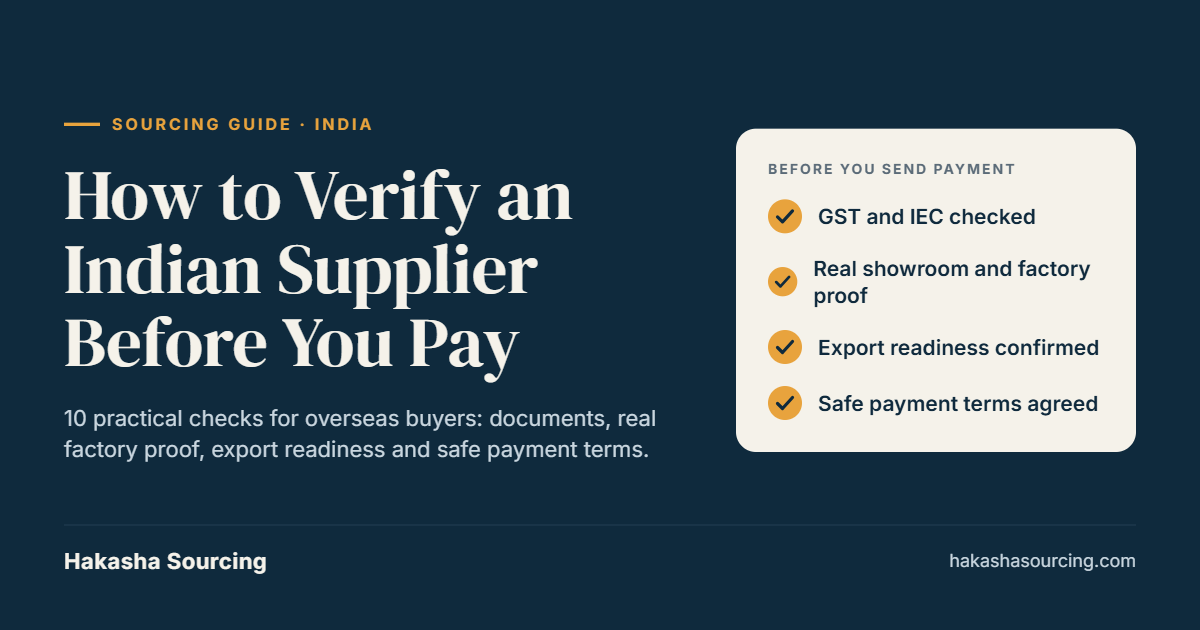
How to Verify an Indian Supplier Before Sending Payment
Worried about import scams? Discover a 10-step practical guide on how to verify an Indian supplier before sending payment. Learn how to check GST numbers, verify your manufacturer's Import Export Code (IEC), spot AI image traps, audit factories, and secure safe payment terms to protect your international orders.
A practical guide for overseas buyers sourcing products from India
For international buyers, one of the biggest concerns when sourcing from India is simple: can I trust this supplier before I send payment?
India is home to thousands of genuine manufacturers, exporters, and artisan businesses. But successful sourcing takes more than attractive product photos and competitive pricing. You need to confirm that the supplier can actually make the product, export it, document it, and deliver what they are showing you.
Most problems do not appear during quotation discussions. They appear later, when production is finished and the shipment is ready to leave India. A few days of verification up front can save weeks of delay and a lot of unnecessary cost.
Here are ten practical steps to reduce supplier risk and verify an Indian manufacturer before you pay.
Why Supplier Verification Matters
Confirms real manufacturing capability and export readiness.
Prevents shipment delays and costly surprises at the final stage.
Lays the foundation for a secure, long-term supplier relationship.
1. Verify Business Registration
Start by confirming that the supplier is a legitimate business. Ask for:
Company registration details
GST registration number
Import Export Code (IEC)
Registered company address
Official website and a business email domain
Don't just collect these documents—check them. GST numbers can be looked up on the official GST portal, and an IEC can be checked through the DGFT (Directorate General of Foreign Trade) website. Make sure the name and address match what the supplier has told you and what appears on the invoice and bank account.
Red Flag: A professional exporter should share these details without hesitation. If a supplier refuses, or works only through personal email accounts, verify further before going ahead.
2. Check Their Digital Presence
Review the supplier's online presence carefully. Look for:
A professional website and product catalogue
An active LinkedIn presence
Trade fair participation and export history
Customer references
A good website is a positive sign, but it should never be the only basis for approval. Cross-check company information across several sources and make sure it is consistent.
3. Don't Rely Solely on Catalogues and AI-Generated Images
Now that AI image tools are common, many suppliers use AI-generated product images, 3D renders, or heavily enhanced presentations. They look attractive, but they do not always show what can realistically be manufactured.
We have seen buyers approve products from beautiful digital renderings, only to find during production that decorative details, proportions, textures, or finishes could not be reproduced in real life.
Before selecting a new supplier, ask for:
Recent showroom photographs and videos
Factory walkthrough videos
Production photos of previous orders
A live video call showing actual inventory
A genuine manufacturer can show real products, not just computer-generated designs.
4. Request Product Samples
Before committing to a large order, request physical samples and evaluate:
Material quality and finish consistency
Design accuracy and weight
Packaging standards
Communication and responsiveness
Keep in mind that a good sample does not guarantee consistent mass production. Ongoing quality control remains essential.
5. Confirm Manufacturing and Export Capability
Not every supplier is a manufacturer, and manufacturing ability is not the same as export ability. Ask direct questions:
Do you manufacture the product yourself, or are operations subcontracted?
What is your production capacity?
Which countries do you regularly export to?
Have you handled similar products for international buyers?
Companies with established export experience are usually much better prepared for international documentation and communication.
6. Verify Export Readiness and Documentation
This is one of the most overlooked steps. Buyers focus on quality and price but forget to confirm that the supplier can actually export smoothly. Discuss these points before placing the order:
An active Import Export Code (IEC)
AD Code registration, which links the exporter's shipping bills to their bank
Port or airport registration
RCMC (Registration-Cum-Membership Certificate), where relevant to the product category (such as EPCH for handicrafts)
Best Practice: Don't wait until production is complete. Confirm export readiness before the order is placed and before sending any substantial payment.
7. Conduct a Factory Audit
A factory audit checks that the supplier's operations match their claims by reviewing production facilities, workforce structure, and quality control systems. If you cannot visit India in person, hiring a local representative to conduct an independent factory audit gives you vital visibility.
8. Use a Local Sourcing Partner
Many overseas buyers cannot visit factories personally. A trusted local sourcing partner can handle supplier identification, verification, factory audits, sample coordination, price negotiation, and quality inspections. At Hakasha Sourcing, this is exactly the on-the-ground support we provide for international buyers so you aren't relying blindly on emails and catalogues.
9. Agree on Safe Payment Terms
Even a well-verified supplier should not receive the full amount up front. Before you pay:
Avoid 100% advance payment. A common structure is a part advance (e.g., 30%) to start production, with the balance paid against inspection or before shipment.
Pay only to a company bank account whose name matches the registered business name on the commercial invoice. Never send money to personal accounts.
Confirm any change of bank details by phone or video call. Last-minute bank detail changes are a common import scam.
10. Start with a Trial Order
Even after verification, avoid placing a massive order straight away. Begin with a pilot order or a small production run to evaluate quality consistency, communication, delivery performance, and problem-solving.
Common Warning Signs of an Untrustworthy Supplier
The supplier cannot provide business registration, GST, or IEC details.
The catalogue contains only rendered or AI-generated images.
No recent showroom photos or factory videos are available.
Prices are unrealistically lower than competing suppliers.
The supplier resists video calls or factory verification.
Bank details change unexpectedly via email.
Indian Supplier Verification Checklist
Before sending payment, confirm that you have checked:
[ ] Business registration, GST, and IEC verified
[ ] Export readiness and documentation discussed
[ ] Physical product samples reviewed
[ ] Showroom photos or factory videos received
[ ] Manufacturing capability confirmed
[ ] Factory audit completed (if required)
[ ] Payment terms documented and bank account matched to company name
[ ] Trial order planned or completed
Final Thoughts
Successful sourcing from India starts long before production begins. The most reliable buyers do not judge suppliers on price or digital presentations alone; they verify manufacturing capability, export readiness, and real production experience.
Planning to source from India? Hakasha Sourcing offers comprehensive supplier verification, factory assessments, and on-ground sourcing support for overseas buyers. Contact us for a professional supplier check before you pay.
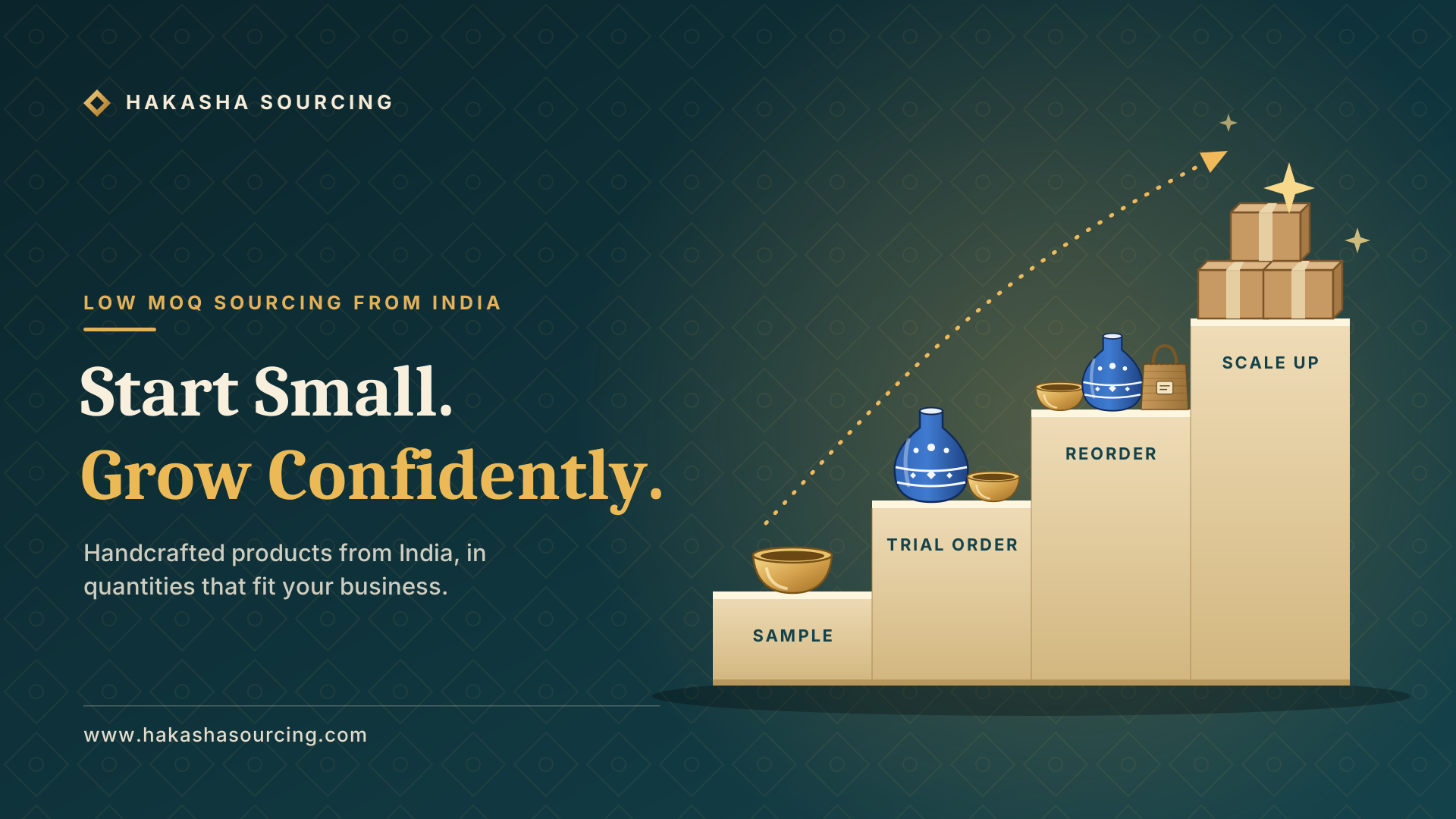
Low MOQ Sourcing from India: How Growing Brands Can Start Small
Struggling with high MOQs? Learn how small retailers and startup brands can source handcrafted products from India with low minimum orders.
Starting or expanding a retail business is exciting, but it often comes with one major challenge: meeting supplier minimum order quantities (MOQs).
Many manufacturers prefer large-volume orders, which makes it hard for small retailers, boutique stores, online sellers, and startup brands to access quality products without taking on heavy inventory risk.
At Hakasha Sourcing, we believe growth should be accessible to businesses of all sizes.
Flexible Sourcing for Small and Growing Businesses
Not every buyer is ready to place a container-load order. Many successful brands begin with small trial orders to test their market, learn what customers want, and build confidence before scaling up.
MOQs vary by product and category, but we work with manufacturers who are open to:
Small trial orders well below standard volumes
Product sampling and testing
Customization and exclusive designs
Mixed-product sourcing
New business collaborations
Handcrafted Products with Global Potential
India is home to some of the world’s finest artisan clusters, producing handcrafted products that retailers and lifestyle brands around the world increasingly look for. Popular categories include:
Brass and metal décor
Serving trays and tableware
Wellness and aromatherapy accessories
Blue pottery and ceramics
Jute and sustainable bags
Handmade home décor and gift items
These products help smaller businesses stand out with authentic, artisan-crafted collections.
Who Benefits from Starting Small?
Low-MOQ sourcing works especially well for:
Boutique gift stores
Online marketplace sellers
Home décor brands
Wellness businesses
Hospitality and concept stores
For these businesses, starting with manageable quantities is a smart and sustainable way to grow. The goal isn’t simply to buy products. It’s to build a reliable supply chain that grows alongside your business.
How It Works
Share your requirements. Tell us what you’re looking for, your target quantities, and your budget.
Review options and samples. We identify suitable manufacturers and coordinate sampling.
Approve a trial order. Start small and test the product with your customers.
Scale with confidence. Once the product works for you, we help you grow your orders.
Quality You Can Rely On
For small buyers, one bad shipment can be costly. That’s why we support every order with supplier verification, factory audits, production monitoring, and pre-shipment inspections, so you know what you’re getting before it leaves India. We also handle consolidation and export coordination to keep the process simple.
How Hakasha Sourcing Can Help
Hakasha Sourcing helps buyers identify reliable manufacturers, evaluate product quality, coordinate communication, and source products that match their business needs. Every successful business starts somewhere, and often it starts with a small order.
Looking for handcrafted products from India with flexible quantities? Tell us what you need and your target quantity, and we’ll come back with options and sample timelines.
Email: kashif@hakashasourcing.com